

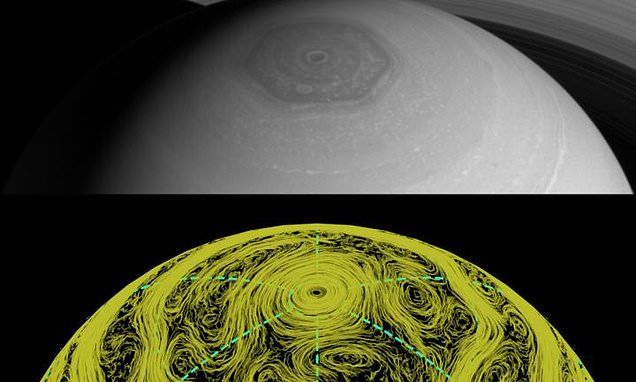

Scientists with NASA’s Hubble Space Telescope have detected an impressive new formation in the atmosphere of Saturn. A giant, 10-sided wave-like feature high above the south pole has been observed spreading around the planet. It is the first regular, polygonal-shaped jet stream large enough to be seen in Saturn’s south. The north pole of Saturn has been noted for its unending hexagonal jet streama shape discovered by Voyager in the early 80s, and examined closely by the Cassini spacecraftthat has attracted the curiosity of the scientific community for more than 40 years. Research also sought to discover if a mirror image to the north reached the second pole, but it seemed unlikely for a long time.
The 13 years that Cassini spent circling the planet revealed no such shape at the south pole, and photographic evidence from the ground and the Hubble Space Telescope failed to reveal a shape anywhere in the south either. This all changed when Saturn’s gradual orbital precession brought its south pole once again into view from Earth. The Outer Planet Atmospheres Legacy program using the Hubble Telescope began capturing images of the planet’s south pole in 2023, which revealed the presence of a polygonal shape. Over subsequent years, the shape became more evident, and by 2025 the edges of a decidagon were clearly observed.
Radio telescopes on the ground detected that the wave was present at multiple atmospheric depths, not just at the planet’s cloud tops. The shape occurs inside one of the gigantic eastward jet streams of Saturn near 60 to 63 deg south, and is somewhat larger than the planet itself, measuring about thirteen thousand km across. The sides of the decagon (not to scale) are over ten thousand miles in length.
While the flanking sides of the north polar hexagon have remained largely unchanged for half a century, the shape of the south still seems to be changing; the points of the decagon reach back and forth over a timescale of about thirty-two days and the contrast of the feature has been increasing over the last few years. Scientists think that the decagon is a large-scale atmospheric wave captured and formed by the shape of the jet around it.
The current theory is that an individual anticyclonic storm nearby, or some sort of periodic forcing of the jet itself, excites the wave but the exact process is still being worked on. The relatively recent formation of the pattern (sometime between the Cassini end of mission in 2017 and the obvious first detections with the HST in 2023) is much more so it’s current evolution as a geometric wave can be observed rather than inferring a relatively existing occurrences.
The finding undermines the distinctiveness once believed to be inherent in the northern hexagon. As Saturn has produced a six-sided wave as well as a ten sided wave poleward of its current researcher can be forgiven for surmising that polyhedral jet streams are, in some ways, perhaps a more expected result of a giant planetary system’s layout and dynamics than had erstwhile been thought.