

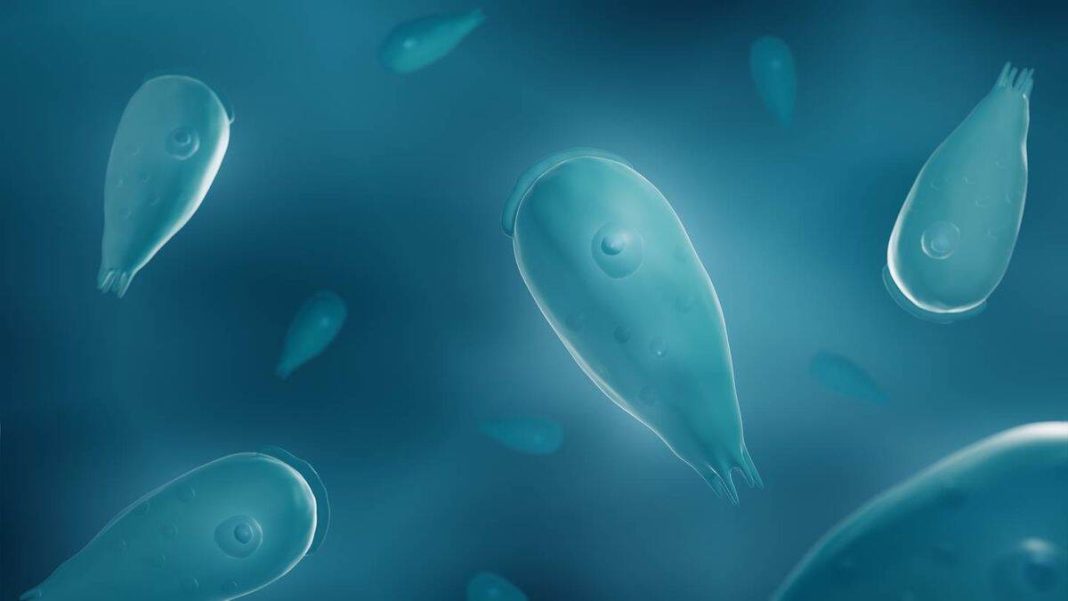

Researchers have found an extraordinary new type of amoeba thriving in the geothermal waters found inside California’s Lassen Volcanic National Park. The amoeba, which can live and reproduce at near-hot (145 degrees F; 63 degrees C), was discovered by researchers who say it may survive at temperatures near the upper temperature limit to complex life.
This finding would give a new temperature record for already known eukaryotic life forms. Eukaryotes are any life forms whose cells have a nucleus and other complex structures such as animals, plants, fungi, and many microorganisms. It was thought up until now that eukaryotes could not grow at temperatures higher than 140F or 60C, and the maximum temperature for amoeba growth was recorded at just below 135F or 57C.
It was found by microbiologist Beryl Rappaport and others on surface water samples taken from geothermal streams of the state of Nowhere near Lake County in the Lassen Volcanic National park. By use of a microscope Rappaport observed a strange organism in the samples exhibiting the known motility of an amoeba. The organism was then cultured in the lab and ramped up in temperature.
The outcome of the experiment was unexpected. Incendiamoeba cascadensis was still dividing through mitosis at 63C. This is not to be confused with just surviving high temperatures as this actually involves growth. This proposed the hypothesis that complex cellular organisms can continue to be biologically active at higher temperatures.
The amoeba’s natural range of temperature is essentially any condition, which is at least a little lower, say possibly around 131F/ 55C to 135F/ 57C. In their experiments the temperature at which no growth was observed was approximately 108F/ 42C so, the extreme heat is not just tolerated by the amoeba.
Its temperature range is not limited to that which enables its unprecedented rapid growth. At about 147 degrees Fahrenheit, or 64 degree Celsius, the fire amoeba can stay alive and be motile, because of this continuing to traverse the environment and look for nourishment. At higher temperatures, the organism can “go into a protective dormant state.” Experiments in the lab have demonstrated that the cells can be revived after a short exposure to 158 degrees Fahrenheit, or 70 degree Celsius, although the cells were incapable of further regular reproduction at this temperature.
Researchers speculate that the unusual heat tolerance of the amoeba is due to adaptations that will help shield its cells from the heat. Genes were discovered through genome analysis that were involved in many functions like the stabilization of proteins, the repair of DNA, and the cellular support. P. ubique can undergo morphological changes and form a siliceous exoskeleton in cases of abnormal stress; this may help shield the proteins and DNA from the heat.
The findings may because of this have broader ramifications than merely shedding light on a unusual microorganism. Since extremophiles are studied by researchers concerned with the limits of life on Earth, as well, their response, and adaptations, to conditions like those present during the amoeba experiments may help to guide astrobiology research. Studying the amoeba in particular, with NASA support, so has relevance both in microbiology and astrobiology.