

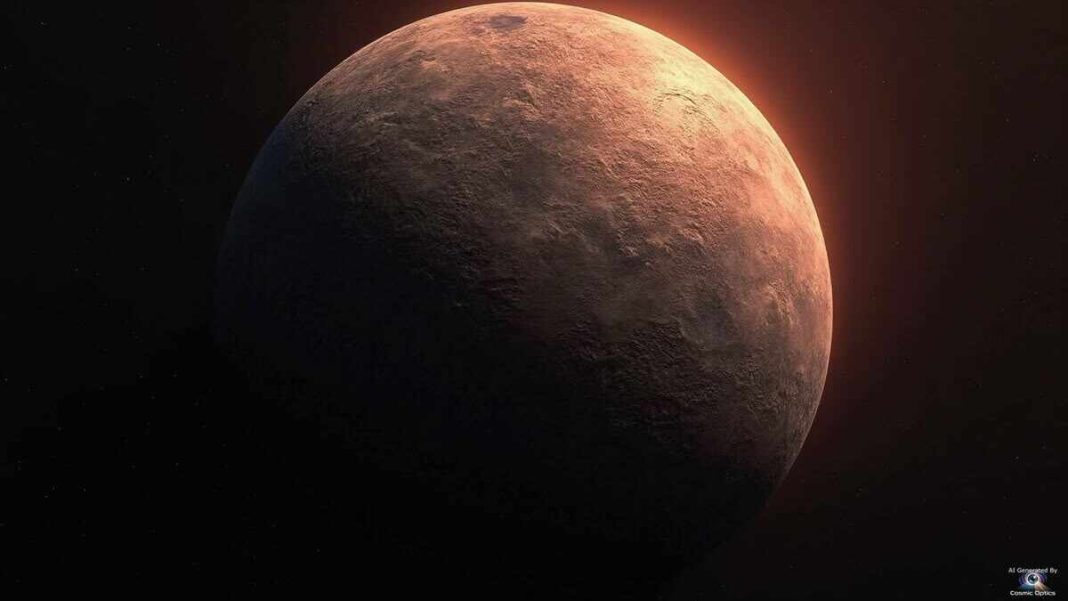

Astronomers have announced the discovery of a remarkably young planet that is less than one million years old, meaning Elias 2-24 b is the youngest planet yet known. As the young world’s is still contained within the disk of gas and dust circling its star, this discovery presents a rare chance for scientists to witness planet formation in a very early stage. Details of the discovery were released in The Astrophysical Journal Letters on September 16.
Elias 2-24 b is a giant planet orbiting the 1-10 million year young star Elias 2-24 which is about 450 light-years from earth.4 The mass of Elias 2-24 b is roughly within a fraction of Jupiter’s mass but this depends heavily on the model used.4 Elias 2-24 b orbits its star at a distance of about 55 AU from the star which is a huge distance for a giant planet to have formed in less than a million years so this is an interesting discovery.
Elias 2-24’s planet was not identified through a normal transit observation. The researchers identified the planet by observing a large gap existing in the protoplanetary disk around Elias 2-24. This protoplanetary disk has gas dust icy and rocky material from the protoplanet’s formation process. The gravitational pull of a growing planet enables material from the protoplanetary disk to be expelled from its original orbit and its own gap.
The astronomers were aware of the gap around Elias 2-24 for some time. The Atacama Large Millimeter/submillimeter Array and European Southern Observatory Very Large Telescope had already revealed anomalous features of the disk as well as a dim light source. The astronomers then examined W. M. Keck Observatory archival data from 2018 and 2020 and after analyzing the images took the source’s movement to be compatible with a planetary body.
A coronograph was even more critical to the discovery of Elias 2-24 b. The coronograph suppresses the brilliancy of a star and made it possible to look for objects further away that are much weaker than the star. In this case it enabled the detection of a planet still heavily embedded in the dusty environment of formation.
What makes this discovery is the extreme youth of the planet. All planets before Elias 2-24b were more than five million years old: PDS 70b was about eight million years, and WISPIT 2 between five and six. Elias 2-24b so gives insight into giant-planet formation far earlier than any other planet known to scientists.
This discovery might challenge other established theories of planetary formation as well. It is a problem in current planetary formation models to be able to create a planet with a mass of that of Jupiter in the orbital distance of Elias 2-24 b in less than a million years. Elias 2-24 bis apparent accretion from the disk shows that one could be seeing a planet at a very fast stage of accumulation.