

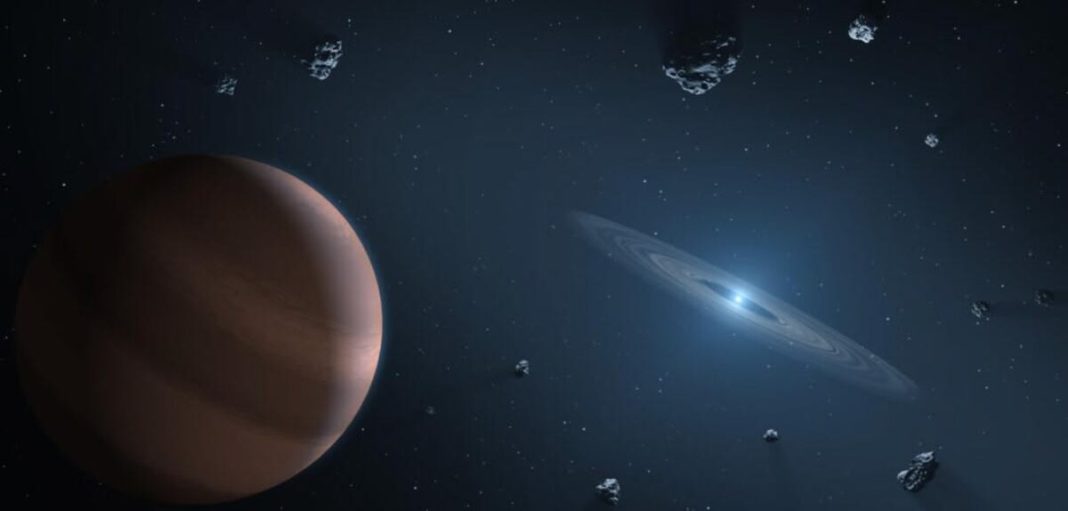

A planet might be in the process of forming or somehow surviving around a stellar remnant, astronomers say, a discovery that could upend current theories about when planets can form. The candidate planet is orbiting around HS 0209+0832, a white dwarf about 270 light-years from Earth. If confirmed, the team’s observations could provide a new window into planetary formation and star evolution.
The study, published in Nature Astronomy on October 5 2026 is based on data gathered decades ago by NASA’s Hubble Space Telescope. Instead of finding a planet in a recent image, researchers reviewed earlier ultraviolet readings and recognized chemical signatures that had not been explained for over 25 years.
A white dwarf is a small, hot star that is the remains of a sun-like star after it has run out of nuclear fuel and thrown off its outer layers. While the core of the star is now much smaller than it was when it was a star, it can still be quite hot. Researchers have found planets that persisted after their star became a white dwarf, but finding planets born from these strippings is much more difficult.
“The team zeroed in on the odd chemical makeup of HS 0209+0832. The star was observed by Hubble back in 1999 and its ultraviolet spectrum showed about 100 lines we couldn’t identify, ” the statement reads. After adopting more recent atomic data, the team attributed lines in the spectrum to a handful of elements, like niobium, copper, and zinc.
“Niobium stood out since it was found in an extraordinary abundance, for a white dwarf. It is an element that can be generated by neutron-capture reactions, which take place in the advanced phases of stellar evolution, and its appearance, together with other strange chemical features, indicates that the white dwarf accreted debris from the star’s death.
The team also checked previously recorded data from a now-defunct NASA mission called the Far Ultraviolet Spectroscopic Explorer to confirm the chemical evidence. These measurements corroborated the unique niobium signs.
NASA’s Transiting Exoplanet Survey Satellite (TESS) provided another significant piece of evidence. TESS detected recurring changes in brightness within the white dwarf system, occurring every roughly 4.4 days. One possible interpretation is that a giant planet is orbiting the star at a close distance, estimated at about six million kilometres.
From what they observe, the researchers argue that the candidate could be a gas planet, about the same size as Jupiter. But the observed brightness variations alone cannot prove the presence of a planet. Fluctuations resulting from material venting out of the system could also be a contributing factor, so additional data will be needed.
The new scenario is set in the late evolution of the star. During its expansion and its loss of the outer layers, the star throws out gas in which elements created during the star’s late evolution are trapped. Part of the expulsion would constitute a disk around the star’s core.