

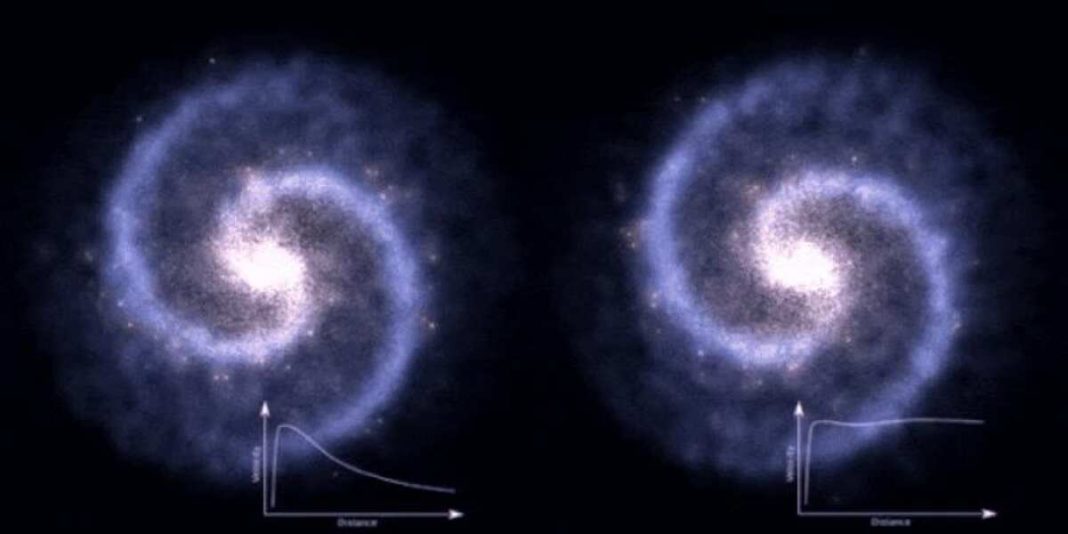

Dark matter has been one of the biggest mysteries in modern science for many years. Despite its imperceptibility, scientists are convinced that it is around 85% of the matter in the universe, and that it guides the motion of galaxies, as well as the overall shape of space itself, by exerting an unseen gravitational force. Now, lots of research is turning toward an exciting new possibility that could alter how we look at space forever: that dark matter interacts with itself via a new kind of force.
This concept has attracted the interest of astronomers and theoretical physicists hoping to find an explanation for the anomalies found in observations that are not accurately modeled by the existing cosmological theories. Although the Lambda Cold Dark Matter model has proven to be an effective theory in describing many aspects of the universe, the formation of some small-scale structures in the universe remains unclear and has led scientists to explore the potential for dark matter to be more complicated than they expected.
Based on Really normal matter emits and reflects light we can see using our telescopes, yet dark matter does neither, we have used the evidence of galaxy rotation, space-time distortion by cluster of galaxies, and the formation of structures after the Big Bang, To wrap up that dark matter exists.
But what it is made of, remains one of the greatest mystery of today. The newest theoretical ideas propose that the particles of dark matter will have a weak, additional force besides gravity, which researchers call a ‘dark force’. This additional force would only act for dark matter, not ordinary matter.
If this is true, this force will affect the process in which galaxies form, collide and grow through billions of years. Computer simulations designed around these theories have also yielded interesting findings. Scientists discovered that by including a further attractive force between dark matter particles, simulated clouds of galaxies could more accurately reflect some astronomical observations.
This could account for the apparent under-density in some galactic centers. This concept has important consequences for the vast, web-like structure which exists on the greatest scales of the universe, the observable universe. This massive structure consists of clusters of galaxies, separate galaxies and the ‘web’ of uncatalogued dark matter filaments that permeate the universe, forming the large scale structure of the universe.
A force that is not seen yet acts upon the dark matter may have a subtle effect on the formation of this structure. Scientists are quick to point out that the theory is still just a hypothesis. There is no experimental evidence directly supporting the existence of an extra dark matter force.
What scientists are doing, is testing mathematical models and using higher resolution data from the latest telescopes and space missions to make comparisons. Many future observatories will be key to testing these theories. The Vera C. Rubin Observatory, the European Space Agency’s Euclid space mission and NASA’s Nancy Grace Roman Space Telescope will provide unparalleled surveys of galaxies and dark matter throughout the cosmos. These could uncover the faint imprints of new theories that will either strengthen or weaken them.