

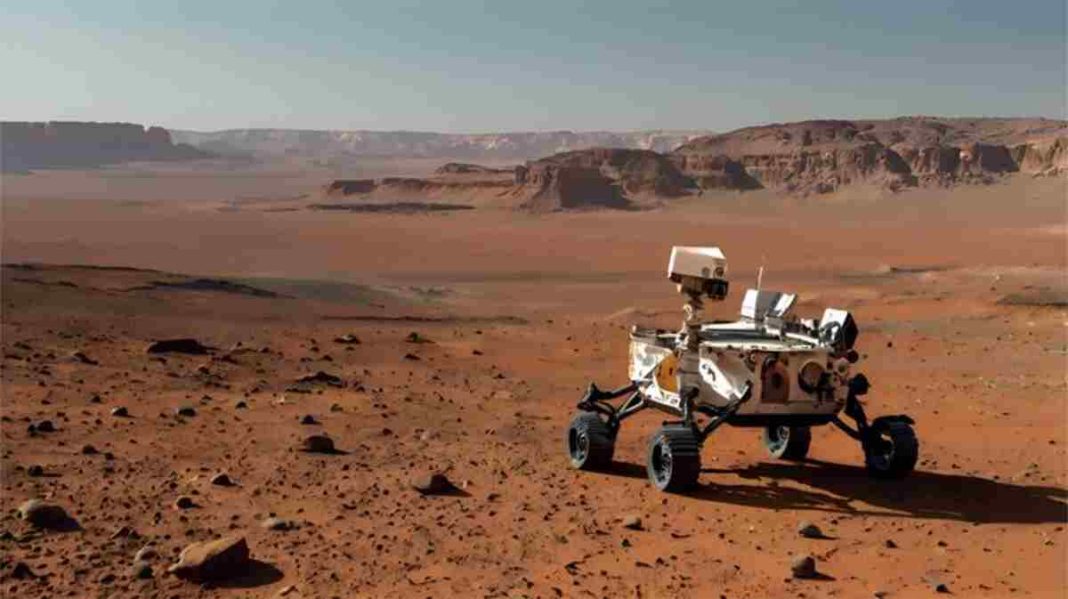

NASA’s Curiosity Camera Witnesses Dazzling Dawn on Mars NASA’s Curiosity rover has taken a stunning snapshot of a Martian dawn, bathed in sunlight as ancient, wind-sculpted rocks on the slopes of Mount Sharp. The newly released panorama offers another perspective of distant features called yardangs and allows scientists to analyze a landscape sculpted over billions of years.
(See the complete image.) This panorama was taken by a camera on the rover Curiosity on Aug. 11, 2026 (Earth days after landing) at roughly 8:30 a.m. local Mars time. The image’s assembled image was composed by joining together six images the camera shot and then sending back to earth. Areas of the image’s foreground appear with blue tones, while bright, morning sunlight was seen falling across jagged formations far away.
While a more conventional Mars image that is processed to represent what people would perceive, on average, through a microscope imaging system when scientists use equalized lighting observation, the new panorama highlights the scene’s appearance early in a Martian morning. What we behold is a spectacular landscape with an orange sky and a blue contrast high noon for sunrise a spectacle at once so similar to-home yet so unearthly foreign. “The rugged environment looks comparable to the iconic Monument Valley in Arizona, ” said Curiosity project scientist Ashwin Vasavada, but “with the red planet sky and sunlines obviously it’s a whole different world.”
The highlight of the picture is the faraway yardangs. These ridges and cliffs had been shaped by mighty Martian winds over very long durations. “It is mostly assumed these layers of rock have been initially shaped by wind blown fabric, may be sandstone, or implausible stuff like volcanic ash from an associated magma job in Gale Crater, ” stated the science crew.
A most of all intriguing aspect of the yardang layer (yet another feature on Mount Sharp) is that it doesn’t seem to fit in with the overall sequence of layers building up this mountain. Researchers are confident it is above an unconformity, a pause in the deposition of material on the planet’s surface, where eroded, more ancient material was swept away before new deposits were laid down. Analysis of the yardang layer could so unveil differences that occurred on Mars that aren’t captured in other sequences of layers on the planet.
The formations are also very large. The yardang layer extends roughly 16 km across the northwestern flank of Mount Sharp. In the new photo, the formations appear in the foreground from afar, but Curiosity is closing in. NASA believes the rover will arrive at the foot of the yardang layer some time in 2027, when one or more of its scientific tools may be able to analyze the rocks on the spot and give a much more comprehensive estimate of what they are made of and the story they might tell.
The Curiosity rover has been exploring Gale Crater since the rover set down on Mars in 2012. The crew-dropped rock-hound has been ascending Mount Sharp, a 5-km mountain rise that is contained solely within the crater since 2014. By late September 2026, the Curiosity had ascended roughly 1 km, the highest elevation the orbiter gained on Mars.
The climb itself is scientifically important as Mount Sharp features strata that are like the chapters of Martian history. Curiosity’s studies have revealed that Gale Crater was once awash with lakes and streams, implying that ancient Mars was far wetter and warmer than the cold.