

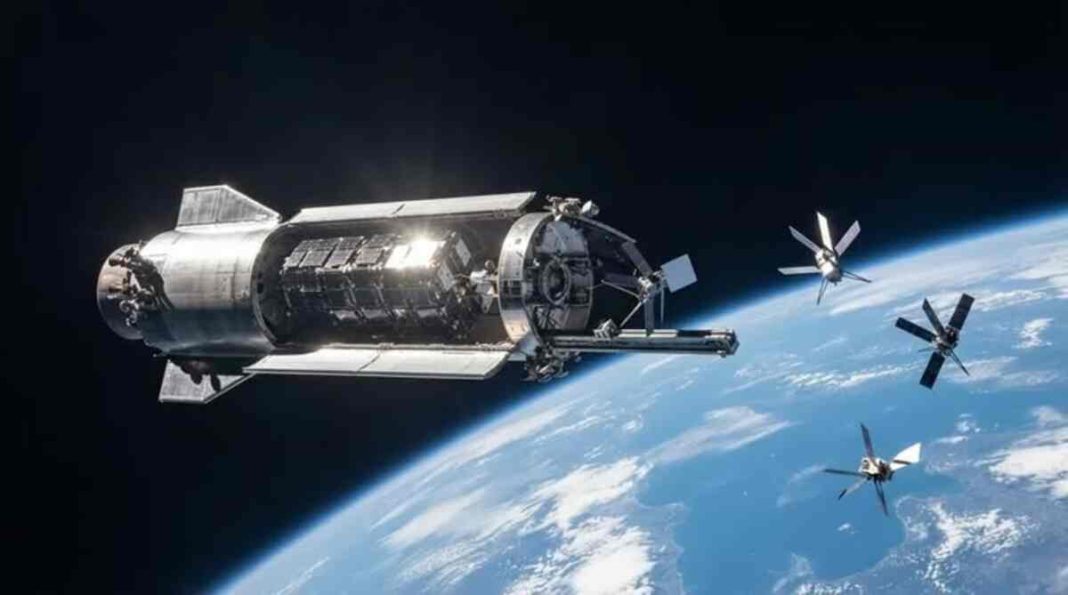

SpaceX just passed a milestone its been chasing for years. On Monday morning, the companys giant Starship rocket launched from the launch pad at Starbase, south Texas, flew into space, and for the first time ever entered a stable orbit around the planet. En route, it also deployed 26 of its newest Starlink satellites, transforming what has been a series of high-profile test flights into a functioning mission.
The 14 th flight of the Starship system took off just before 8 am local time. All33 engines on the Super Heavy booster fired at any rate. One engine stopped working in the middle of the ascent, but the booster did its job and splashed into the Gulf of Mexico. The upper stage, known as Ship, continued on its own. Soon after separation, one of its own0 Raptor was disabled. For a time, it appeared the attempt at orbit might be abandoned. Flight controllers examined the information and decided that the 19 remaining engines still could make it. They approved a brief burn to slide into orbit. Eight nineto n seconds later, the Starship was orbiting the Earth.
That moment was significant. The previous missions reached the edge of space and returned. This one did not. At about 170 miles in altitude the payload bay door opened and the vehicle started the deployment of the Starlink V3 satellites one by one. This took about half an hour. All 26 were successfully deployed from the ship and eventually confirmed to be in good condition. They are much larger and more powerful than the Falcon 9 satellites. They are capable of providing much higher performance and this was their first commercial mission into space.
The target was nearly 10 hours in orbit, and about six complete orbits of the earth. Due to the earlier engine failure though SpaceX played safe and terminated the mission after just three hours. Re-entry and splashdown in the Pacific off Hawaii resulted in the usual conflagration as the remaining fuel burned, an old friend in previous tests. Still, the main objectives had been achieved.
For SpaceX the flight is more than a technical tick box. Starship’s aim is to replace the incumbent workhorse of the launch industry by ferrying large payloads, refuelling in orbit and ultimately ferrying humans to the Moon and Mars. Reaching orbit and deploying genuine satellites demonstrates the vehicle is capable of rather more than just maintaining itself in flight. It also gives a significant injection in capacity for the Starlink network, at a time when demand for space-based internet continues to grow.
The flight team and Elon Musk called the flight an overall success even though the vehicle returned home early. The heat-shield, engine, and deployed satellite data will inform the next vehicles already waiting at the launch facility. The next flights will increase orbit duration, perfect touch and go landings, and move towards grasping the ship and booster with the launch tower arms.