

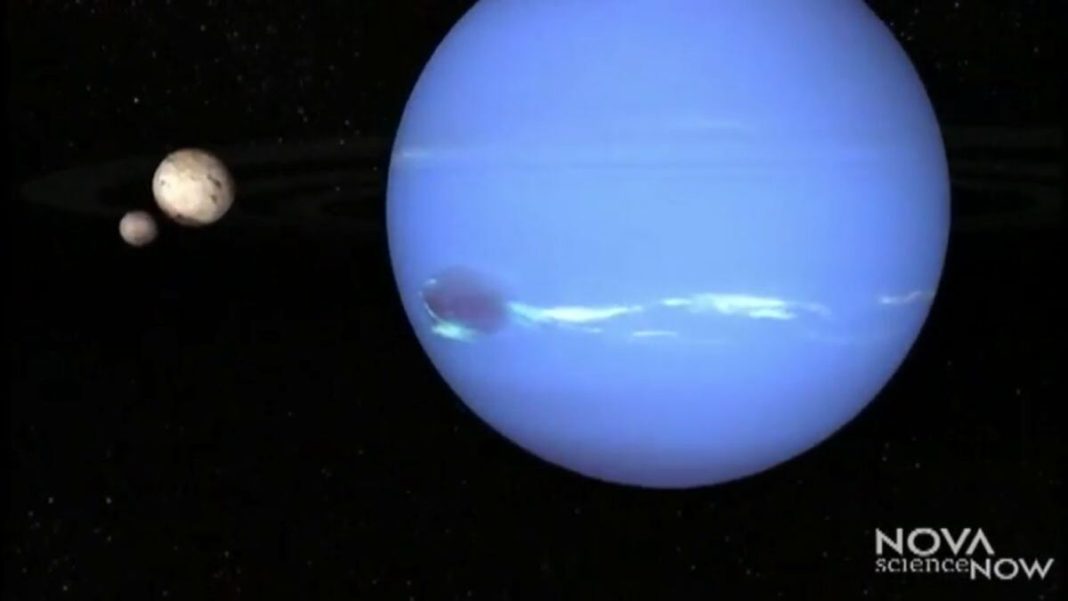

The new data coming back from the James Webb Space Telescope have rewritten the early history of Neptune’s interior moons and rings. Researchers at the California Institute of Technology have uncovered chemical clues in three of the planet’s tiny moons (Proteus, Larissa and Galatea) and its dusty rings that suggest a tumultuous past. They seem not to have accreted silently in place, but rather to be the shrapnel of huge icy bodies, smashed to smithereens billions of years ago.
By using Webb’s Near-Infrared Spectrograph, scientists studied the light reflected from the moons and rings. And what they found was a shock. The deposits reveal numerous deep absorption features related to hydroxyl groups and, even more remarkably, a very strong high-silica absorption feature characteristic of magnesium-rich clay minerals (phyllosilicates).
These clays result from the prolonged interaction of water with rock deep within a fully differentiated object. Both the moons are too small and cold for this process to be occurring on their surfaces even today. To account for the presence of these phyllosilicates, there is only one other place they could have come from: the interior of a much larger ancient satellite or even a primordial dwarf-planet-sized body which has since been lost to us. The most probable agent of destruction would have been Triton, Neptune’s massive and anomalously inclined largest moon. Most think that Triton is a captured object from the Kuiper Belt, that was ensnared into orbit around Neptune during the early days of the solar system formation.
After capture, and during its early eccentric period, Triton would have gravitationally excited the pre-existing regular satellite system. This would have perturbed the regular moons that previously orbited Neptune in more predictable orbits, throwing them into crossing orbits and causing collisions with one another. The debris from these collisions would then have re-coalesced into the tight irregular, moons, and rings group seen today.
It is the very lack of water ice deposition on the inner satellites and rings that should be so surprising about the Webb results. Water ice should be prevalent throughout the outer solar system, yet was lost in the high energy collisions of the Triton arrival, whatever water ice remained was swiftly destroyed (surviving only in the deep, more insulated layers of the parent bodies, which after the collision, went on to create the NCP clusters). In principle the current inner Neptunian satellites provide a very special glimpse into the protoplanetary interior of the destroyed outer worlds of the solar system.
Lead author Ryleigh Davis et al. state that if Neptune did have a moon system once existing like that of the current one around Uranus, it would have been nearly eroded by Triton’s capture. Very little remaining debris was able to reach the rings and small satellites, while a majority was either expelled out of the system or gained entry into Neptune. The findings, published in Science Advances show the capabilities of Webb’s infrared abilities for planetary science. The previous missions, like Voyager 2, could strike images of the moons, yet had insufficient spectroscopic sensitivity to display the surface composition to this extents.